Materials
Why we make bags from plants, not "plant-based" plastic
"Plant-based" is one of the most misleading words on a bag. Here's what's actually inside a compostable bag (PLA, PHA, PBAT, TPS), how the blends work, and why certification matters more than feedstock alone.
May 13, 2026
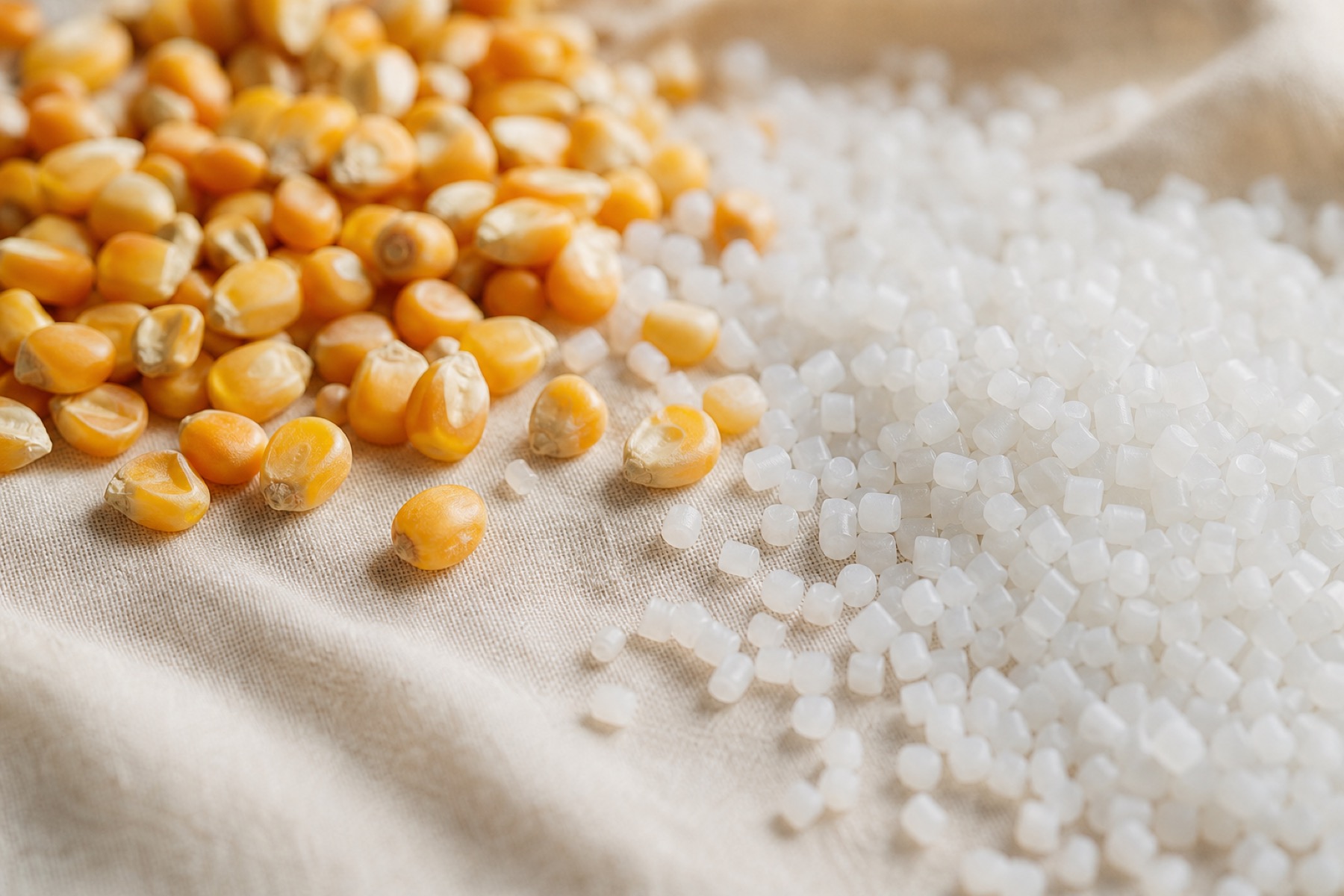
The phrase "plant-based" on a bag tells you almost nothing. A bag can be 30% corn-derived plastic and 70% fossil-fuel resin and still legally call itself plant-based. A bag can also be 100% bio-derived and still fail every meaningful compost test. Material origin and material performance are two different questions, and the difference is where most of the greenwashing in this category lives.
Here's what actually goes into a compostable bag, what each of those materials does, and why we ended up choosing the blend we did.
The four materials people lump together
When you read "plant-based" or "bioplastic" or "compostable plastic" on a label, the bag is almost certainly made from one or more of these:
PLA (polylactic acid)
PLA is the most familiar bioplastic. It's polymerized from lactic acid, which is fermented from plant sugars, usually corn starch in the US. PLA on its own is rigid and brittle (think clear cold-drink cups). For a bag, it has to be blended with something more flexible. PLA composts well in industrial facilities, but very slowly at home temperatures.
PHA (polyhydroxyalkanoates)
PHA is a family of polymers produced inside microbes that ferment plant feedstocks or, in newer processes, methane and other gases. PHA is the most genuinely versatile of the four: it breaks down in industrial composting, in home composting, in soil, and even in marine environments. It is also still relatively expensive, which is why pure PHA bags are rare.
PBAT (polybutylene adipate terephthalate)
PBAT is the workhorse of the compostable-flexibles category, and the one most likely to surprise people. It is fossil-fuel-derived, not plant-based. It is also certified biodegradable and is what gives most compostable bags their flexibility and tear resistance. PBAT alone wouldn't make a bag plant-based, but it's almost always blended with bio-derived materials to get both performance and bio-content.
TPS (thermoplastic starch)
TPS is starch (typically corn or potato) plasticized with glycerol and water to make it processable like a plastic. It is 100% bio-derived, breaks down quickly in any composting environment, and is cheap. It's also sensitive to moisture, which is why it's blended rather than used alone in most bags.
Why blends matter
A real compostable bag is almost always two or three of these materials at once.
A common formulation is PLA for body and printability, PBAT for flex and tear strength, and TPS for cost and bio-content. Some premium formulations swap in PHA for better home composting and soil performance.
A bag made of 100% PLA would be too brittle to use. A bag made of 100% PBAT would compost fine but contain zero bio-content. A bag made of 100% TPS would dissolve in your hand the first time it got wet. The blend is the bag.
This is where the "plant-based" claim gets slippery. A bag can be advertised as plant-based when it contains as little as 20 to 40% bio-content, because there's no federal definition that sets a floor. The FTC's Green Guides are advisory, not enforceable in the way a USDA Organic mark is.
Why certification matters more than feedstock alone
A bag made entirely of bio-content can still fail ASTM D6400 (it might leave behind residue, or contain a colorant or additive that breaks the standard's eco-toxicity test). A bag containing fossil-fuel PBAT can pass D6400 cleanly, because the standard measures performance in a composting environment, not where the carbon originally came from.
The lesson: feedstock is interesting. Certification is what matters. The right question to ask about a compostable bag isn't "is it made from plants" but "is it certified to a real composting standard, and which one?"
We talk through how to read those certifications in our [labels post]. The short version: look for BPI, ASTM D6400 or D6868, OK Compost (or OK Compost Home), CMA. Ignore everything else.
What we chose, and why
Our bags use a blend of PLA, PBAT, and TPS, with bio-content above industry typical, certified to ASTM D6400 (industrial) and OK Compost Home (backyard).
A few of the calls we made along the way:
- We held out for a formulation that passes both industrial and home certifications, so the same bag works for a curbside program or a backyard pile.
- We chose a blend with measurable bio-content rather than a 100% fossil-derived PBAT bag, because feedstock origin still matters even if certification doesn't depend on it.
- We avoided PHA-only formulations, for now, because cost would have pushed the bag out of reach for everyday kitchen use. We'll revisit as PHA pricing improves.
A bag is a series of trade-offs. The most honest thing we can do is tell you what those trade-offs are, instead of waving a "plant-based" sticker and hoping you don't ask.
Frequently asked questions
Is a "plant-based" bag automatically compostable?
No. Plant-based describes where the carbon comes from. Compostable describes what happens to the bag in a composting environment. The two can overlap, but plenty of plant-based products are not compostable, and some certified compostable products contain fossil-derived materials like PBAT.
What is the difference between PLA and PBAT?
PLA is plant-derived (usually from corn starch) and rigid. PBAT is fossil-derived and flexible. Both are certified biodegradable under industrial composting conditions, and almost every compostable bag on the market uses a blend of one or both to balance performance and bio-content.
Is PHA the best compostable material?
PHA breaks down in the widest range of environments (industrial, home, soil, and marine), which makes it the most versatile of the common bioplastics. It is also currently the most expensive, which is why pure PHA bags are rare. As production scales, expect PHA to show up more often in everyday products.
Why isn't your bag 100% plant-based?
Because performance and certification matter more than feedstock alone. A 100% bio-content bag would either be too brittle (PLA-heavy), too soft (TPS-heavy), or significantly more expensive (PHA-heavy). The blend we use delivers a bag that's durable enough to actually use, certified for both industrial and home composting, and has bio-content above what most "plant-based" bags on the shelf actually contain.