Introduction · Issue 01
We make bags.
Compost unmakes them.
A short introduction to what we do, why we do it, the standards we hold ourselves to, and how a partnership with us begins.
groundupbags.com
contact@groundupbags.com
For prospective partners
Read in 8 minutes
02 / 14 · Hello
Strong enough to carry. Honest about the rest.
GroundUp Bags is a US-based compostable packaging company. We design and supply a small, deliberate range of bags engineered to break down inside real composting environments, certified to recognized standards, and made to behave like the conventional plastic they replace.
We are not an oxo-fragmenting product wrapped in a green leaf. We are a company that takes the word “compostable” seriously enough to test for it, certify it, and tell you what it does not do.
This document is for buyers, distributors, foodservice operators, municipalities, and brand teams considering a switch from conventional plastic packaging. It tries to be specific about what we are good at, where the trade-offs live, and how working with us is different from working with the alternative.
Mission
Replace single-use plastic where reduction is not possible, with material certified to break down in compost.
Focus
US market. Industrial and home composting. Certified product only.
Honesty
A compostable bag only works when it reaches compost. We say so. Loudly.
03 / 14 · The problem
We are making more plastic than the planet can absorb. Most of it lives once.
Global plastic production reached 460 million tonnes in 2019, roughly double its level in 2000. Of that, just 9% was recycled. Around half went to landfills. The remaining 22% was burned in open pits, leaked into ecosystems, or otherwise mismanaged.
Packaging is the single largest application, responsible for 40% of global plastic waste. It is also the application with the shortest useful life: most plastic packaging is used once and discarded within minutes of leaving a store.
In the United States, landfilling that waste is itself a climate problem. Landfills are the third-largest source of human-caused methane emissions in the US, behind cattle and natural gas systems, and methane traps roughly 80 times more heat than carbon dioxide over a 20-year horizon.
Sources: OECD Global Plastics Outlook 2022. EPA 2024 Inventory of US GHG Emissions and Sinks (1990–2022), Chapter 7.
460 Mt
Global plastic production in 2019, up from 234 Mt in 2000. OECD.
9%
Of global plastic waste was actually recycled. The rest went to landfill, incineration, or the environment. OECD.
17.1%
Of total US human-caused methane emissions came from landfills in 2022. EPA 2024.
40%
Of all plastic waste is packaging. The largest application by waste volume. OECD.
04 / 14 · The gap
The market is full of products that perform like plastic, or like marketing. Rarely both.
A buyer looking to replace single-use plastic packaging today runs into three problems at once.
01
Vague claims
Labels like “eco-friendly” and “biodegradable” have no enforceable US definition. Most product comparisons fall apart the moment you ask which certification it carries.
02
Imported uncertainty
Many compostable bags on US shelves are imported, with certifications that don’t map to US municipal organics program requirements. The bag may pass a lab test and still be rejected at the compost gate.
03
Compromise on performance
Conventional plastic alternatives that genuinely break down often fail on strength, water resistance, or printability. Buyers end up choosing between sustainability and shelf reality.
Our work is to close the gap between what a compostable bag promises on a label and what it does in a working composting facility, in a US zip code, at a price a real procurement team can defend.
05 / 14 · Our answer
Plant-based film, certified to the marks each product lists, tuned to US conditions.
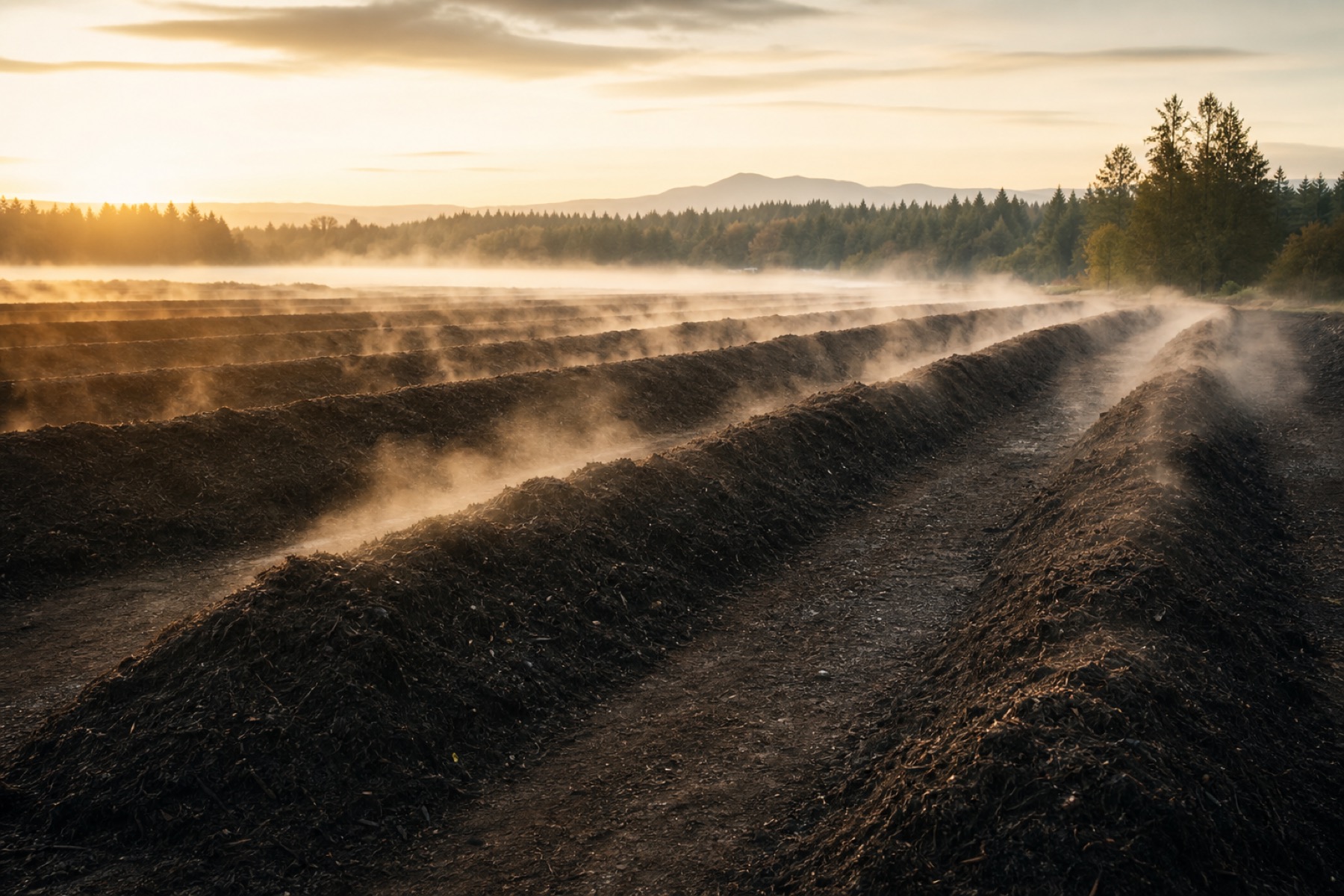
We make compostable bags from a deliberate blend of plant-derived PLA, biodegradable PBAT, and thermoplastic starch. The blend is chosen, not advertised. It survives a real shopping run and a real backyard pile.
Every product in the range carries third-party compostability certification. Industrial marks (BPI / ASTM D6400) apply across the finished-bag range. OK Compost HOME applies only where the product listing says so. We do not treat a lab certificate as a promise that every US facility will accept the bag.
We size the range to the destinations a US household or business can actually reach: curbside organics where it exists, industrial composting where it doesn’t, and properly managed home compost as a default fallback.
06 / 14 · Materials
A blend, not a buzzword.
A bag is a series of trade-offs between rigidity, flexibility, tear resistance, breathability, and breakdown speed. No single bio-based polymer hits all five. We use three, in proportions tuned per product family.
PLA
Polylactic acid
Fermented from plant sugars (typically corn starch). Provides rigidity and printability. Rigid on its own, so it is always part of a blend in our films.
Origin
Plant-derived
PBAT
Polybutylene adipate terephthalate
Fossil-derived but biodegradable. Gives the film its flexibility, tear resistance, and seal strength. Tested and certified under ASTM D6400.
Origin
Fossil-derived
TPS
Thermoplastic starch
Plant starch (corn or potato) plasticized for film extrusion. Adds bio-content, accelerates breakdown, lowers cost. Moisture-sensitive on its own, so always blended.
Origin
Plant-derived
Why blend at all? A 100% PLA bag is too brittle to use. A 100% PBAT bag has no bio-content. A 100% TPS bag dissolves in your hand the first time it gets wet. The blend is the product.
07 / 14 · Capability
What we can run, and what we can hold to.
Reel widths
Up to 60 in
Standard converting widths supported. Wider on request.
Film gauge
1.0–4.0 mil
Light produce film through heavy-duty yard / can liners.
Up to 4 colors
Water-based, compostable-certified flexo. Pantone matching within film tolerance.
Finishes
5 standard
Translucent, frosted, opaque; matte and soft-touch on request.
Lead time
6–8 weeks
From artwork sign-off, including custom flexo plate-making and QA.
MOQ
50,000 units
Our standard for finished bags. Rolls and films start at 500 kg. Smaller first runs are welcomed for the right brief.
08 / 14 · Certifications
Marks an independent lab actually signed off.
BPI Certified
01
Verified by BPI
Issued by Biodegradable Products Institute
Independent US certification confirming compostability in industrial composting facilities. A mark many North American municipal organics programs look for; local acceptance still varies.
ASTM D6400
02
Industrial compostability
Issued by ASTM International
The North American specification for plastics designed to compost in municipal and industrial facilities. This is the standard BPI certification verifies against.
OK Compost HOME
03
Home composting
Issued by TÜV Austria
Tested to break down completely in the cooler, slower conditions of a backyard compost heap, not just industrial facilities.
EN 13432
04
European compostability
Issued by European Standard
The European benchmark for compostable packaging: at least 90% disintegration in 12 weeks and 90% biodegradation in 6 months.
ASTM D6400-23 source: ASTM International. BPI: Biodegradable Products Institute. OK Compost HOME: TÜV Austria. EN 13432: European Committee for Standardization.
09 / 14 · Range at a glance
16 families. Built around how a bag is used.
Full product specifications, sizes, and MOQs are in our Product Booklet. This is the quick view.
Carry
Vest & shopping bags · 90–180 days in active compost
E-commerce mailers · 120 days in industrial compost
Produce
Produce bags · 90 days in active compost
Walk
Pet waste bags · 90–120 days in active compost
Pack
Apparel & retail bags · 180 days in active compost
Seal
Resealable food storage · 150 days in active compost
Kitchen
Caddy liners · 60–90 days in active compost
Yard
Yard & leaf bags · 180 days in industrial compost
Liner
Industrial can liners · 180 days in industrial compost
Shop
Shopping bags with handles · 180 days in active compost
Pouch
Small-item pouches · 120 days in active compost
Takeaway
Takeaway & delivery bags · 120 days in active compost
Film
Sheets, films & wrappers · 180 days in industrial compost
Guard
Anti-static electronics bags · 180 days in industrial compost
Field
Agricultural mulch film · One growing season, varies by climate and burial conditions
Custom
Made to order · As per base product
10 / 14 · Customer segments
Six segments. Different scales. Same standard.
Grocery & specialty retail
Vest, produce, and yard bags compatible with curbside organics.
Restaurants & foodservice
Caddy liners, can liners, takeaway bags, and food storage.
Direct-to-consumer brands
Mailers and retail bags with custom print, sized to USPS rate breaks.
Apparel & lifestyle
Frosted and clear apparel bags for boutique and online stores.
Municipalities & haulers
Yard and can liners certified for BPI-accepting compost facilities.
Hospitality & institutions
Reinforced compostable liners for cafeterias, hotels, and offices.
11 / 14 · Partnership
A short, specific process. Not a sales funnel.
We work with a small number of partners well, rather than a large number poorly. Here is how a first conversation usually unfolds.
01
Brief
Week 1
You tell us what you ship today, what volume, and the end-of-life environment your customers are actually in. We tell you which family of ours replaces it and which doesn’t.
02
Samples
Week 1–2
Stock samples ship within 5–10 business days. Custom-spec samples take 2–3 weeks depending on print and gauge.
03
Quote & spec
Week 2–3
Per-unit pricing, freight terms, MOQ, and lead time for the specific SKU mix you need. We flag any spec request that compromises compostability before it gets locked in.
04
Production
Week 4–10
Standard 6–8 weeks from artwork sign-off, including QA. Expedite is possible on a case-by-case basis.
05
Delivery & ongoing supply
Ongoing
Single-PO or recurring drop-ship. We hold a small safety stock for partners on a regular cadence.
12 / 14 · The bigger picture
A bag is not a climate solution. A system is.
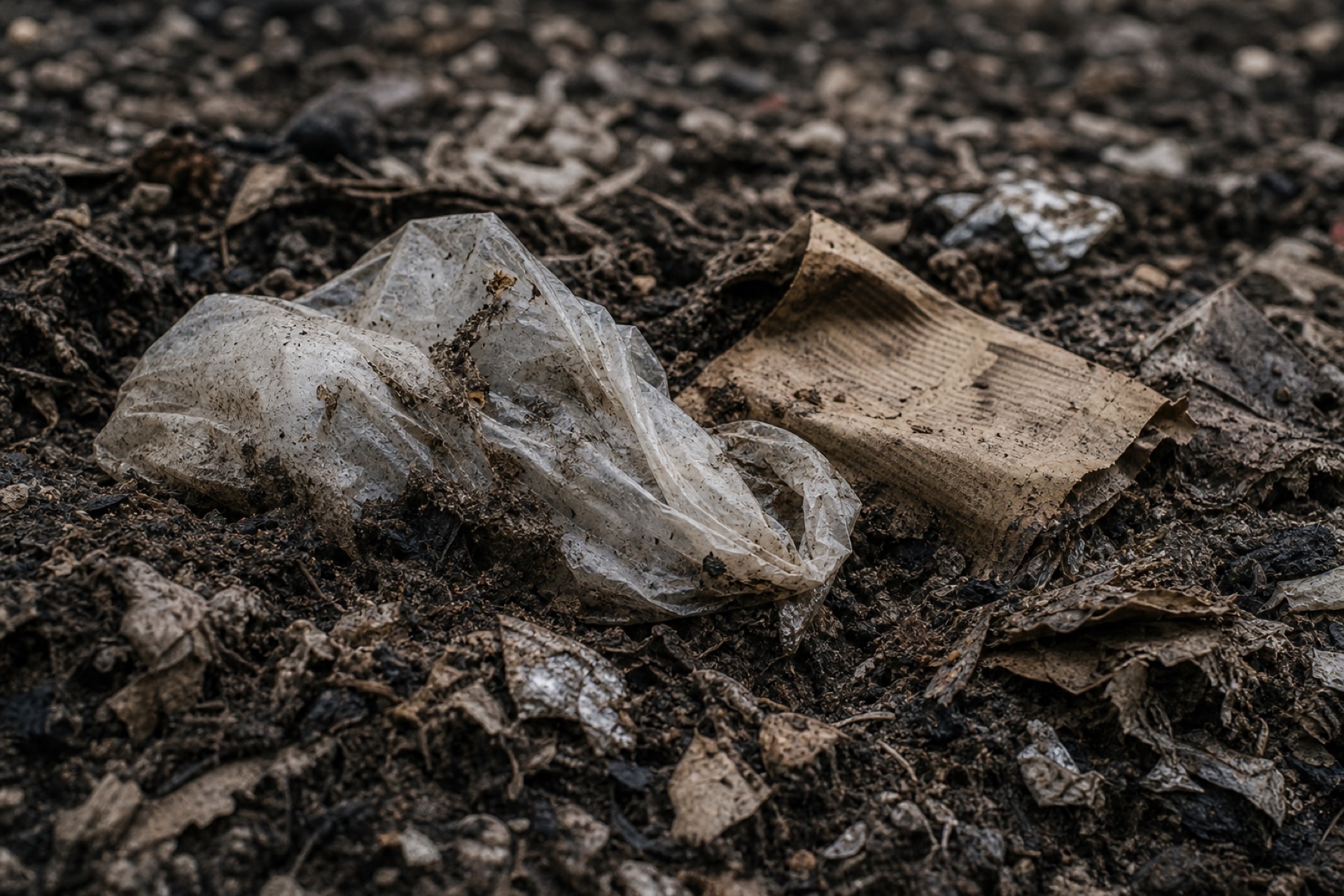
The honest measure of a compostable bag is not the bag. It is whether the bag, and what it carries, ends up in a place where it can decompose.
Curbside organics pickup is expanding rapidly in the US. California’s SB 1383 mandate now requires statewide organic-waste diversion. Vermont, Oregon, Washington, parts of New York and Massachusetts, plus a growing list of metro programs, are doing the same.
We make products that work inside that infrastructure. We also make products that work in a backyard pile, for households without curbside service. Our job is to be ready for the system that is forming, and to make sure that when it reaches a given zip code, a credible bag is already on the shelf.
13 / 14 · Closing
We are not trying to be the biggest. We are trying to be the one you trust when a buyer asks “why this one?”
If the products in our range fit a brief you are working on, we would like to hear from you. Plain email is fine. Specifics help.
Get in touch
The next step is
a short reply.
contact@groundupbags.com
Website
groundupbags.com
Companion document
Product Booklet