
Education
Biodegradable vs compostable bags
Biodegradable vs compostable plastic bags
Apr 3, 2026
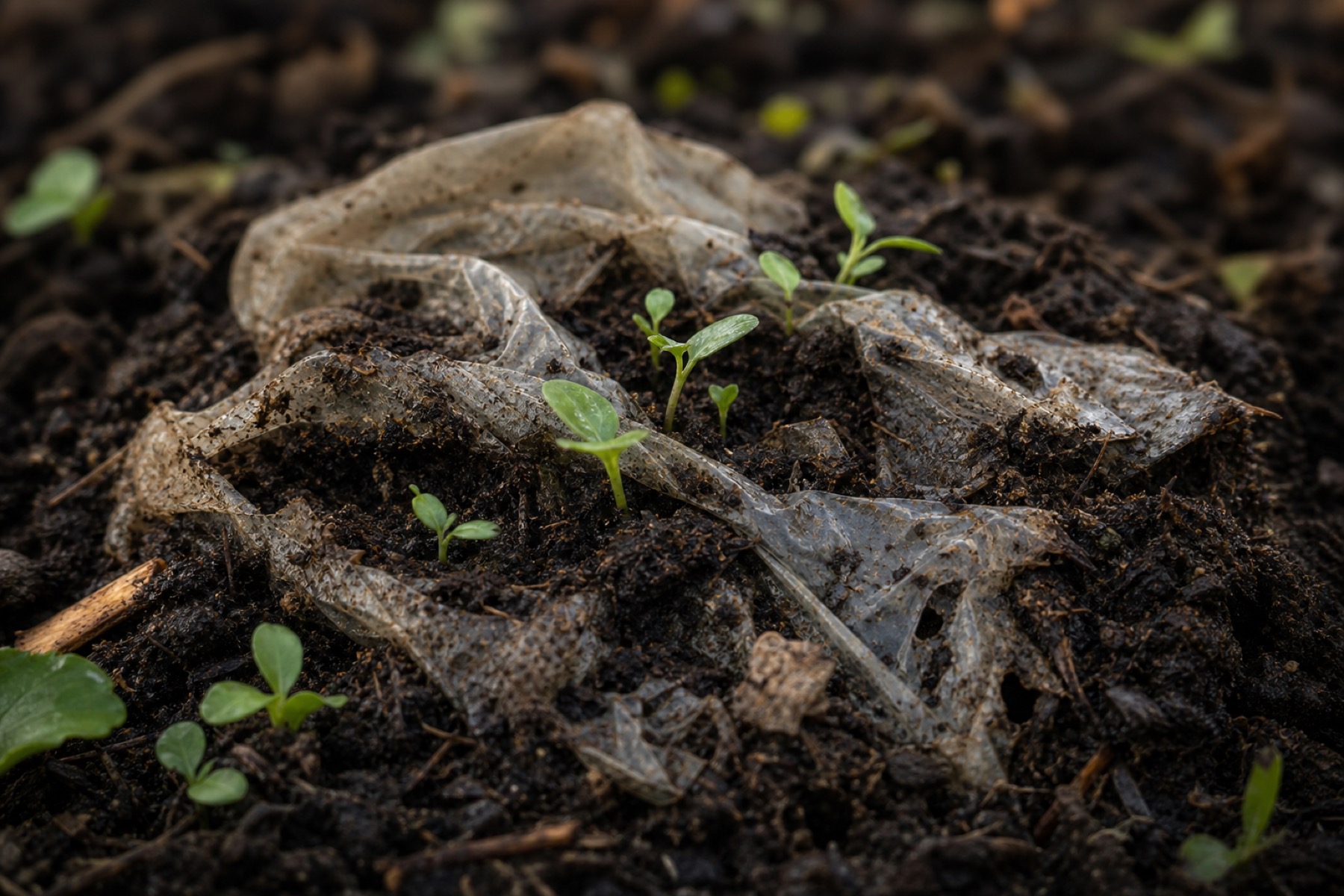
There are two words you see on every "eco-friendly" label at the grocery store: biodegradable and compostable. They sound interchangeable. They are not. The difference matters for what actually happens to that bag after you throw it away.
The short answer
"Biodegradable" is a marketing term with no legal definition in the United States. A plastic shopping bag that breaks down into smaller plastic fragments over four hundred years is, technically, biodegradable. A glass bottle is biodegradable, given a few thousand years. So is a car tire.
"Compostable" is the opposite. It is defined by national and international standards, tested by independent laboratories, and verified to break down into water, carbon dioxide, and biomass within a measurable window. No microplastics. No toxic residue.
If a label says "biodegradable" and nothing else, assume it means almost nothing. If it says Certified Compostable alongside a logo from BPI, ASTM D6400, OK Compost HOME, or the EU Seedling, the product has been put through a defined test and passed.
What "biodegradable" actually means
The word describes any material that can be broken down by living organisms (bacteria, fungi, microbes) into smaller components. There is no required timeline. There is no required end state. There is no required environment.
Under that definition, a conventional polyethylene grocery bag qualifies. So does an aluminum can. Both will, over geological time, eventually disintegrate. A landfill operator does not care whether a material is biodegradable in this sense. The bag still takes up the same volume in the ground.
The U.S. Federal Trade Commission's Green Guides flag "biodegradable" as a claim that is misleading unless the marketer specifies the conditions and timeframe under which the material breaks down. Most products that use the word do not provide that context.
What "compostable" actually means
"Compostable" is a regulated claim in the United States, the European Union, and several other markets. To use the label legitimately, a manufacturer submits material samples to an accredited lab and proves the product meets a defined standard. The major standards are:
- ASTM D6400 (United States). Industrial composting conditions. Sets thresholds for biodegradation, disintegration, ecotoxicity, and heavy metals content.
- EN 13432 (European Union). The harmonized European standard. Functionally similar to D6400, with slightly different test conditions and the seedling logo as the consumer-facing mark.
- OK Compost HOME (TÜV Austria). The stricter, home-compost version. Verifies the material will fully break down at ambient temperatures of 68 to 86 °F, not the 130 to 140 °F of industrial facilities.
A product that carries one of these certifications has been independently tested for the conditions it was certified against. The certifying body retains the right to spot-check production batches.
The U.S. consumer-facing certification most often referenced on retail packaging is BPI Certified, issued by the Biodegradable Products Institute against the ASTM D6400 standard. The BPI logo is what curbside organics programs look for when deciding which bags to accept.
For the specific test thresholds behind each certification, see our certifications page.
How to read a label
Three quick checks:
- Look for a certification logo, not a marketing claim. The word "biodegradable" alone, with no certification mark, is functionally a marketing word. The word "compostable" accompanied by a logo (BPI, OK Compost HOME, the EU Seedling, or ASTM D6400) is a regulated claim.
- Read the conditions. A certified compostable product will state whether it is industrial-compostable, home-compostable, or both. "Compostable in industrial facilities only" is honest and useful information. "Compostable" without context is ambiguous.
- Check whether the brand discloses what the bag is made of. Plant-based compounds typically state their constituents (cassava, corn, PBAT, PLA). Vague claims like "eco-friendly plastic" or "made with plants" with no further detail often mean a conventional polymer with a degradation additive.
What happens to a biodegradable bag in a landfill
Landfills are designed to suppress biological activity. They are sealed, low-oxygen environments deliberately engineered to keep organic matter stable so the landfill does not collapse on itself or release methane uncontrollably.
A bag thrown into a curbside trash bin, biodegradable or otherwise, ends up there. In that environment, even a certified compostable bag does not compost. There is not enough air. There is not enough microbial activity at the necessary scale. The bag persists.
For "biodegradable" plastics specifically, the additional problem is fragmentation. Many products marketed as biodegradable are conventional plastics treated with a pro-oxidant additive that makes them break down into smaller pieces faster. The smaller pieces are not gone. They are microplastics.
A 2019 study by researchers at the University of Plymouth, published in Environmental Science and Technology, tested four types of plastic bags (conventional, biodegradable, oxo-biodegradable, and compostable) buried in soil and submerged in seawater. After three years, the biodegradable, oxo-biodegradable, and conventional bags were all still intact in soil and could still carry shopping. The "biodegradable" label, in practice, had accelerated fragmentation without accelerating disappearance.
What happens to a certified compostable bag in compost
In an active compost stream, whether industrial or home, the bag is exposed to heat, moisture, oxygen, and a microbial community that has evolved over billions of years to break down plant matter. A certified compostable bag is made from materials those microbes recognize: plant-derived starches and PBAT, a polyester chemically structured to biodegrade in the same way that leaves and food scraps do.
In an industrial facility (130 to 140 °F), an ASTM D6400 bag fully disintegrates and biodegrades within 90 to 180 days, depending on the facility. In a home compost (68 to 86 °F), an OK Compost HOME bag takes 6 to 12 months. The end products are water, carbon dioxide, and stable biomass that becomes part of the finished soil. No microplastics. No toxic residue.
The catch is that the bag has to actually reach a compost stream. A certified compostable bag in the trash defeats the purpose. It sits in the landfill alongside conventional plastic, performing no better.
The bottom line
"Biodegradable" tells you, at most, that something will eventually break down. It says nothing about when, where, into what, or under what conditions. It is not a guarantee of any environmental benefit. On a single-use bag specifically, it is often a way to make a plastic product sound green while it does the same thing all the others do.
"Compostable" is what you want. Specifically, Certified Compostable with a verifiable logo on the package. That product has been tested by a third party, against a defined standard, and is proven to return to soil in a measurable window when it ends up in the right stream.
The two words are not synonyms. The difference is the difference between a label and an outcome.
Frequently asked questions
Is every compostable product also biodegradable?
Yes. All certified compostable materials are biodegradable by definition. The reverse is rarely true. Most products labeled "biodegradable" without a compostability certification do not meet a compostable standard.
Will a certified compostable bag break down in my backyard?
Only if it is certified to a home-compost standard, most commonly OK Compost HOME. A bag certified only to ASTM D6400 or EN 13432 requires industrial composting conditions. Look for "Home Compostable" or "OK Compost HOME" on the package.
Can I put compostable bags in U.S. curbside organics collection?
In most U.S. cities that accept compostable bags, yes, provided the bag carries the BPI Certified logo. Acceptance varies by municipality and is expanding as composting infrastructure catches up. Check your local program's accepted-items list before assuming.
Why do compostable bags cost more than conventional plastic?
The feedstock (plant starches, PBAT) is more expensive than petroleum-derived polyethylene, and third-party certification testing adds compliance cost. The price gap has narrowed substantially since 2020 as production has scaled.
Do compostable bags break down in a cupboard?
No. Composting requires moisture, heat, and active microbes. Stored dry, a certified compostable bag stays stable for at least a year.